
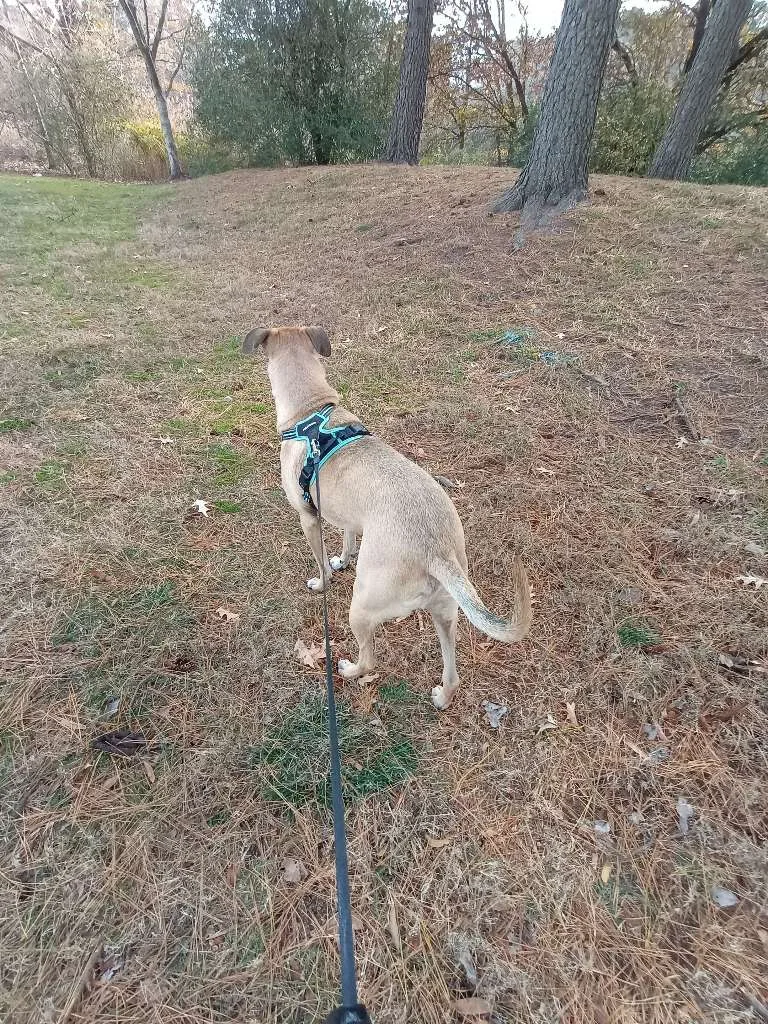
A dog that pulls on leash can turn a simple walk into a full-body workout. For some families, it is annoying. For others, it becomes a real safety issue, especially when the dog is strong, reactive, or determined to get somewhere fast.
As professional dog walkers, we have walked small dogs who pull like they have somewhere urgent to be and large dogs who can move a person several feet before the walker has time to reset. Some pulling improves with a better piece of equipment. Some improves with repetition, patience, and a consistent handling pattern. Some pulling needs a bigger plan than a normal walk can provide.
The first thing to understand is that pulling is not one behavior with one fix. A dog pulling toward home, a dog pulling toward another dog, and a dog pulling toward a squirrel are not all working from the same place. Good leash handling starts by asking why the dog is pulling before deciding what to do about it.
Why Dogs Pull
Dogs pull for a lot of reasons. Some pull from excitement. Some pull because they have never learned how to walk on a loose leash. Others pull because of prey drive, a good scent, poor equipment fit, frustration, or reactivity toward dogs, wheels, cars, bikes, or other triggers.
Correcting the behavior depends on the reason behind the pulling. Sometimes a better harness, collar, leash setup, or walking route makes an immediate difference. Other times, the pulling reflects months or years of learned behavior, and the dog needs consistent training before the walk feels manageable again.
The biggest thing to understand is that dogs do not pull because they are bad. They pull because pulling has become a system that works for them. If a dog learns that pulling gets them closer to the squirrel, the smell, the front door, or the direction they want to go, the behavior keeps getting rewarded.
I once walked an Australian Shepherd who had very little leash training and a strong prey drive. He had learned that if he kept pulling, he could eventually drag the walk toward whatever had his attention. Because he was only an occasional client, we never had the consistency needed to make the walk truly comfortable. That experience matters because it shows how pulling is rarely solved by one trick.
When the Behavior Is as Simple as Changing a Collar
There are a lot of aids for walking strong pullers. They range from martingale collars to prong collars, head halters, and front-clip harnesses. As professional dog walkers, we prefer equipment that redirects the dog rather than equipment that punishes the dog for pulling.
Tools like a Freedom Harness or Gentle Leader work by changing the dog’s leverage. A front-clip harness redirects the front of the body when the dog drives forward. A head halter gives the handler more control over where the dog’s head goes, which changes where the body can follow.
It is not magic, but the right equipment can give the walker a much better starting point. We once walked a powerful dog with serious dog reactivity, and it was imperative that this dog stay away from other dogs. The client had skipped ahead to harsher correction tools, but the dog was still difficult to manage safely.
When we introduced a front-clip harness, the change was immediate. The dog could no longer drive straight ahead with the same force, because the pull redirected the body back toward the walker. Over time, that better setup helped the dog keep more focus near us and walk with a looser leash.
Equipment does not replace training or good handling. It does not erase prey drive, reactivity, or years of learned behavior. But when the equipment matches the dog and the situation, it can make the walk safer, clearer, and more productive for everyone involved.
How to Correct Excitement Pulling
One of our very first clients had a little Schnauzer who just wanted to go home. The neighborhood happened to be a big circle, which made it perfect for a 30-minute walk. The only issue was that the front half and back half of the walk looked completely different.
On the way out, the pace was slower and easier to manage. Once we made the turn and started heading home, everything changed. Our little Schnauzer friend got excited, picked up speed, and started pulling because home had become the reward.
That kind of pulling is not much different from pulling toward a squirrel or a freshly marked patch of grass. The dog wants something, and forward motion becomes the payoff. If the walker keeps moving every time the dog pulls, the dog learns that pulling works.
In that situation, stopping helped because the route was a predictable loop. When the dog pulled toward home, the walk stopped moving toward home. In other situations, turning around and walking the opposite direction works better because it interrupts the reward pattern more clearly.
The point is not to punish the dog. The point is to stop rewarding the pulling. When the dog learns that a loose leash keeps the walk moving and a tight leash stops the progress, the rules become easier to understand.
Why Consistency Matters
Pulling does not always improve in one dramatic moment. Sometimes the pattern changes so slowly that the person doing the daily work barely notices. Then another care team member fills in, walks the dog, and says, “He is doing so much better.”
That is exactly what happened with Rocky. His main walker worked with him day after day, and because the progress came in small pieces, the change was easy to miss. Rocky pulled, kept pulling, and then slowly became easier to walk as the same expectations repeated over time.
The daily structure mattered. Rocky was put in heel position. He had leash restrictions when needed. He was asked to sit when he saw another dog or squirrel, which gave him a clear behavior to practice instead of surging forward.
Over time, the small changes added up. Rocky became much better and much more comfortable to walk, but it did not happen because of one perfect correction. It happened because someone kept giving him the same structure, the same boundaries, and the same chance to practice every day.
This is why strong pullers need consistency from the people walking them. If one person allows pulling, another person stops every time, and another person changes direction, the dog receives several different systems at once. A dog has a much better chance of improving when the rules are clear and repeated.
When Pulling Needs a Bigger Plan
Some pulling cannot be safely handled as a normal walk with normal expectations. Shelby lived up to her name. She pulled like a wild mustang, and after one injured shoulder, we knew she needed a bigger plan.
It is not often that a dog is strong enough to pull a walker off their feet, but Shelby was different. She had a powerful engine and did not seem to have an off switch once she started moving. She had been away at board and train, and everyone expected the walks to become easier when she came back.
Instead, she came back stronger and pulled harder than ever. That surprised the walker, who expected improved behavior rather than a more difficult walk. At that point, the care plan had to change because safety had to come first.
Shelby lived in a house with two other dogs, but she could not be treated as one part of a group walk. She needed to be walked first and alone. She needed two hands, full attention, and a walker focused on her body, her environment, and every possible trigger.
We worked with the client, extended the visit length, and divided the visit into Shelby’s walk and time for the other dogs. That was the right plan for that household because it respected the reality of the dog in front of us. Some dogs need more than a better leash cue. They need a safer structure around the entire walk.
What Professional Dog Walkers Look For
When we walk a dog that pulls, we are paying attention to more than the leash. We are watching what the dog pulls toward, when the pulling starts, how quickly the dog recovers, and whether the dog can respond once they are excited. We are also looking at equipment fit, route choice, strength mismatch, household instructions, and safety concerns.
For some dogs, the answer is a better harness and a clearer walking pattern. For others, the answer is a shorter route, a quieter route, more distance from triggers, or a slower start at the door. For some dogs, the responsible answer is to involve a qualified trainer because the pulling is connected to reactivity, fear, aggression, or unsafe handling risk.
Good dog walking is not about overpowering the dog. It is about understanding what the dog is practicing and whether the walk is rewarding the behavior we want or the behavior we are trying to reduce. The goal is a safer, calmer, more manageable walk for the dog and the person holding the leash.
If your dog pulls, start by looking for the pattern. Notice what happens before the leash gets tight, what the dog wants in that moment, and what reward the dog receives when they pull. Once you understand the reason, you can choose a better setup, a better route, a better handling plan, or the right professional support.
At Stable Hands Pet Care & Services, our dog walking team serves pets in Virginia Beach, Norfolk, and Chesapeake with a focus on calm, reliable, professional care. Strong pullers need more than force. They need observation, structure, consistency, and a plan that fits the dog.